

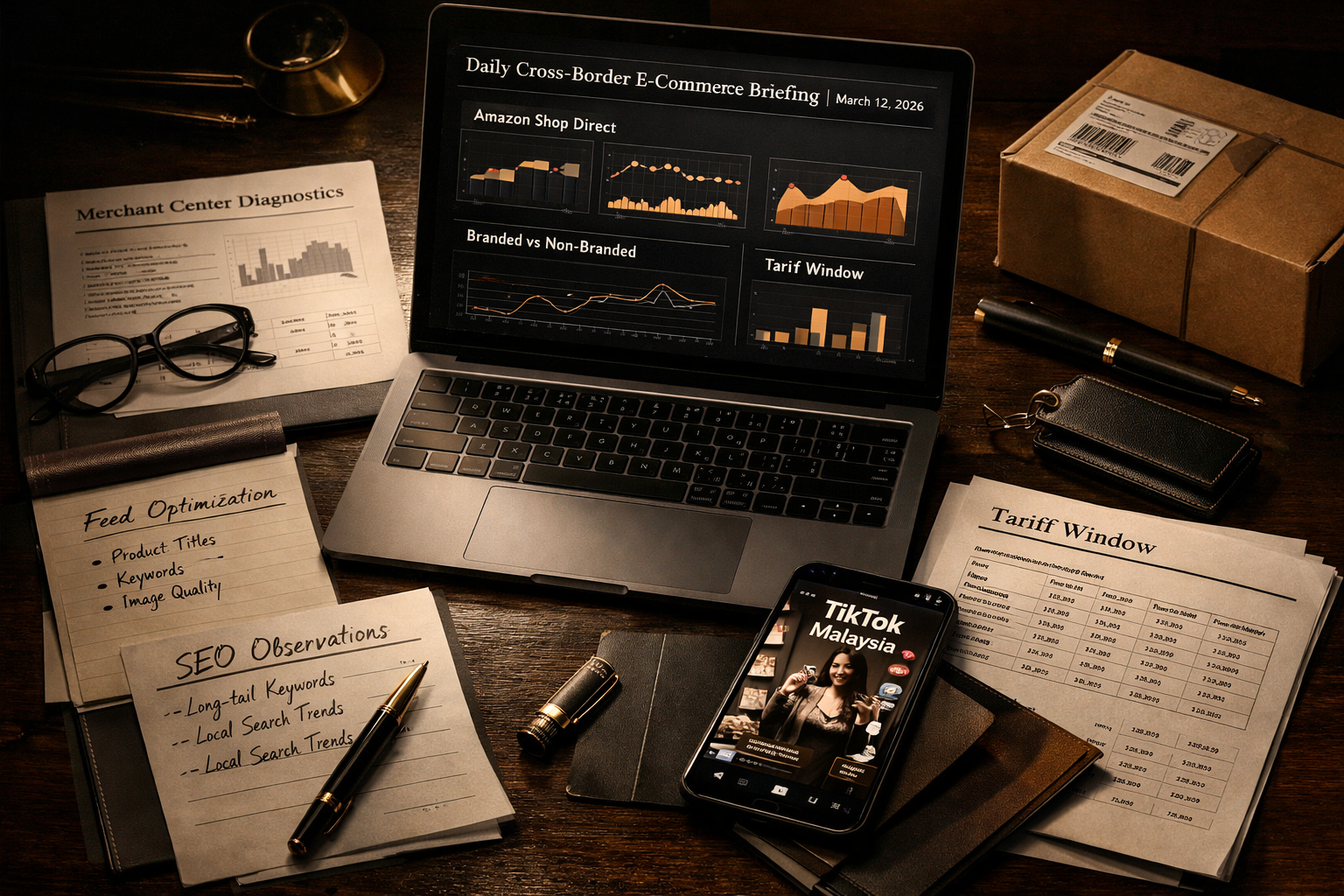
Daily Cross-Border E-Commerce Briefing | March 12, 2026 (Covering Mar 11–12 Releases)
1. Amazon Expands Shop Direct and Buy for Me With Product Feed Access (Independent Stores May Get Amazon Traffic Without Listing Directly on Amazon)
-
Amazon has expanded its AI-enabled shopping infrastructure by opening new feed-based options for
Shop Direct and Buy for Me. In practical terms, this means more merchants can connect product
catalogs through feed partners so Amazon can surface their products to shoppers even when those
products are not sold natively through Amazon’s own marketplace checkout. For independent-store
sellers, this is a meaningful signal that large platforms are becoming traffic gateways as much as
they are marketplaces. If product data, pricing, availability, and variant structure are clean
enough, merchants may be able to capture additional discovery traffic without fully giving up direct
customer ownership on their own site.
For Shopify and WooCommerce sellers, the operational takeaway is clear: structured catalog data is now becoming a growth asset, not just a backend maintenance task. Stores running simple one-piece dropshipping models should pay special attention to title consistency, image accuracy, stock freshness, and dispatch-time realism, because AI-driven shopping surfaces are more sensitive to bad data than traditional storefront browsing. If your catalog is messy, mismatched, or slow to update, you risk poor click quality, disappointed buyers, and avoidable refund pressure. Sellers who want more inbound traffic from large ecosystems should start treating feed hygiene as part of SEO and conversion optimization, not as an afterthought.
Source: Digital Commerce 360, Published on: March 11, 2026
2. Google Search Console Expands Branded vs. Non-Branded Query Reporting (SEO Measurement Gets Much Better for Independent Stores)
-
Google has expanded the branded queries filter in Search Console to all eligible sites, allowing
merchants to separate branded and non-branded search traffic directly inside the native Performance
report. This is more important than it may first appear. Many independent stores have historically
struggled to understand whether their organic traffic growth came from real market discovery or
simply from people already searching their store name. With this update, merchants can distinguish
brand demand from category-level search visibility without exporting data into spreadsheets or
building fragile regex-based filters.
For cross-border sellers trying to grow through content marketing and SEO, this creates a cleaner way to evaluate whether blog posts, collection pages, and product pages are actually acquiring new audiences. If non-branded clicks are rising, your store is gaining broader search reach. If only branded clicks rise, your SEO is behaving more like brand retention than true acquisition. Stores testing one-piece dropshipping products can use this distinction to judge whether a niche is developing real search demand before increasing ad spend. It is also especially useful for blog-led traffic strategies, because it helps identify which content is bringing in people who have never heard of your store before.
Source: Search Engine Land, Published on: March 11, 2026
3. Google Launches Merchant Center for Agencies in the U.S. and Canada (Feed Management and Diagnostics Are Becoming More Centralized)
-
Google is making Merchant Center for Agencies generally available in the United States and Canada,
giving agency teams a single place to manage and monitor multiple merchant accounts with proactive
diagnostics and alerts. Although this announcement is positioned around agencies, the real
e-commerce implication is broader: Google continues to move product-feed management toward a more
centralized, professionalized operating model. That matters because product visibility in Shopping,
Performance Max, and AI-assisted discovery depends increasingly on feed quality, policy compliance,
and quick reaction to account issues.
For smaller independent stores, this is a reminder that Merchant Center is no longer just a setup step for running Shopping ads. It is becoming a core commerce infrastructure layer. Sellers using simple dropshipping workflows should regularly review disapprovals, missing attributes, shipping settings, policy warnings, and image quality before scale periods. If you rely on fast product testing, a single feed issue can quietly choke acquisition. Even merchants not using an outside agency can learn from this trend: build a weekly routine around Merchant Center health, because better diagnostics often translate into stronger visibility, cleaner traffic, and less wasted budget.
Source: Search Engine Land, Published on: March 11, 2026
4. Eight Out of Ten Performance Max Advertisers Are Now Getting CTV Impressions (Your Product Feed May Already Be Showing on TV Screens)
-
Search Engine Land reported that eight out of ten Performance Max advertisers are now receiving
connected TV impressions through YouTube, reflecting how quickly Google has pushed commerce
campaigns onto larger-screen inventory. The critical point for merchants is that many of these
impressions can be generated from standard product feed assets and auto-generated creative, which
means brands may already be appearing in a TV-like environment without intentionally planning for
it. This is a major shift in how paid traffic behaves: your Shopping-style assets are no longer
limited to classic search or mobile placements.
For direct-to-consumer sellers and product-test stores, this creates both opportunity and risk. On the opportunity side, CTV exposure can widen reach and support brand memory. On the risk side, low-quality feed images, weak creative framing, and generic product shots that look acceptable in a shopping carousel may perform poorly on a 65-inch screen. If you operate a one-piece dropshipping model, where catalog turnover is fast, you should check channel breakdowns and review whether your feed assets are visually strong enough for broader surfaces. This is also a warning not to treat PMax as a black box: once channels diversify, creative quality and landing-page consistency matter even more.
Source: Search Engine Land, Published on: March 11, 2026
5. Mastercard Introduces an AI “Virtual C-Suite” for Small Businesses (Commerce Operations and Payments Intelligence Are Getting More Automated)
-
Mastercard has introduced an AI-powered “Virtual C-Suite” for small businesses, beginning with a
Virtual CFO that is designed to provide automated financial analysis, risk insights, and operational
recommendations. While this is not a storefront feature by itself, it matters for e-commerce
merchants because it reflects a larger payments-industry shift: commerce infrastructure providers
are trying to move beyond pure transaction processing and into decision support. For smaller online
sellers, that means the tools surrounding payments, cash flow, receivables, and operational
forecasting are becoming more intelligent and more integrated.
For independent-store operators, especially those managing thin margins, fluctuating ad spend, and supplier-side uncertainty, this trend matters because better finance visibility often drives better inventory and marketing decisions. Sellers using straightforward dropshipping setups may not need enterprise software, but they do need tighter control over contribution margin, refund exposure, and working capital timing. The larger lesson is that payments providers increasingly want to become operating-system partners for merchants. That makes it worth watching which tools offer useful forecasting, dispute insights, and cash-flow guidance rather than just checkout acceptance.
Source: Digital Commerce 360, Published on: March 11, 2026
6. China Export Hubs React to Temporary U.S. Tariff Relief (Short-Term Cost Windows Could Reshape Product Testing and Pricing)
-
Reuters reported that a temporary reprieve in U.S. tariffs is driving a scramble across China’s
export hubs, with some factories and exporters moving quickly to take advantage of a lower-tariff
window while remaining cautious about the longer-term direction of U.S.-China trade. For
cross-border e-commerce sellers, this is highly practical news. Temporary tariff easing can affect
landed cost, sourcing urgency, supplier responsiveness, and promotional room in target markets like
the United States. But because the relief appears time-limited, merchants cannot assume the
lower-cost environment will stay in place.
For Shopify and WooCommerce stores, this creates a useful but narrow strategy window. Sellers can review products that were previously too margin-sensitive to promote in the U.S., refresh pricing tests, or bundle more aggressively while input costs are temporarily more manageable. For one-piece dropshipping sellers, the best approach is flexibility rather than overcommitment: test fast-moving SKUs, monitor supplier quote changes, and avoid writing permanent price promises around what may only be a short-lived policy shift. The broader lesson is that tariff volatility is now part of routine commerce planning, not an occasional exception.
Source: Reuters, Published on: March 11, 2026
7. Gulf Shipping Disruption Starts Hurting Cross-Border Payments Flows (Logistics Delays Can Now Slow Cash Collection Too)
-
The Economic Times reported that the ongoing Gulf-region disruption is beginning to affect
cross-border payments startups because shipment delays and cancellations are slowing merchandise
movement through key routes, including flows linked to the UAE. This is an important development for
online sellers because it shows how logistics disruption no longer stops at late delivery. It can
now directly affect settlement timing, payment confidence, exporter cash flow, and transaction
volume. In other words, when physical movement becomes unstable, money movement can become unstable
as well.
For independent-store merchants selling internationally, especially into the Middle East or through trade routes influenced by Gulf transit, the practical implication is to review both shipping messaging and cash-flow assumptions. Delayed delivery may translate into later payouts, more customer service pressure, and elevated dispute risk. Sellers using simple dropshipping models should be careful with delivery-time promises and should keep clear dispatch records, tracking updates, and refund policies ready. This is also a reminder that payment performance is not only about payment gateways or checkout UX; it can be damaged by upstream logistics instability just as easily.
Source: The Economic Times, Published on: March 11, 2026
8. TikTok’s Reported RM20 Billion Impact in Malaysia Highlights Southeast Asia’s Commerce Potential (Social Commerce Still Matters for Seller Demand)
-
A March 11 report highlighted TikTok’s estimated RM20 billion impact on Malaysia’s economy,
emphasizing how the platform has helped MSMEs expand beyond physical storefronts and build
longer-term business momentum. For cross-border merchants, this matters because Southeast Asia
continues to stand out as a region where social commerce is not just a traffic source but a genuine
buying behavior. The significance is not limited to TikTok Shop itself. It signals that markets like
Malaysia remain highly responsive to creator-led discovery, short-form product storytelling, and
community-driven trust building.
For independent-store sellers, this should reinforce a practical market view: Southeast Asia deserves attention not only as an ad audience, but as a region where product validation can happen faster when content and offer structure are adapted correctly. Sellers testing lightweight, impulse-friendly, visually demonstrable products through simple dropshipping setups may find these markets especially suitable. The key is localization of messaging, transparent shipping expectations, and creator-style content that feels native instead of overly polished. As social commerce ecosystems deepen, merchants who understand regional buying behavior will be in a stronger position than those who only copy U.S.-centric ad strategies.
Source: The Rakyat Post, Published on: March 11, 2026
9. This Week’s New Ecommerce Tool Releases Show a Strong Push Toward Localization, Feed Control, AI Shopping, and Returns Infrastructure (The Merchant Tech Stack Is Getting More Operational)
-
Practical Ecommerce’s March 11 tools roundup highlighted a cluster of launches that point in the
same direction: better localized commerce, stronger product-feed control, more AI-ready payments
infrastructure, and improved fulfillment and returns tooling. Among the most notable developments
were the deeper Klaviyo-Shopify integration for localized catalog data, new AI feed-management
support, expanded fraud intelligence for AI shopping assistants, and additional parcel-locker and
returns capabilities. Taken together, these launches suggest that the next phase of e-commerce
growth will depend less on flashy storefront design alone and more on operational readiness across
product data, localization, risk control, and last-mile convenience.
For independent-site sellers, this is especially relevant because smaller teams often lose efficiency by stitching together too many disconnected tools. If you are running a lean one-piece dropshipping model, the most valuable upgrades are usually the ones that reduce manual correction work: synced localized catalog content, cleaner feed diagnostics, clearer risk signals, and easier return-handling visibility. Instead of chasing every new app, merchants should interpret this release wave as a strategy hint. The winning store stack in 2026 is likely to be lighter, cleaner, and more automation-friendly, with fewer broken handoffs between marketing, product data, checkout, and post-purchase service.
Source: Practical Ecommerce, Published on: March 11, 2026


