

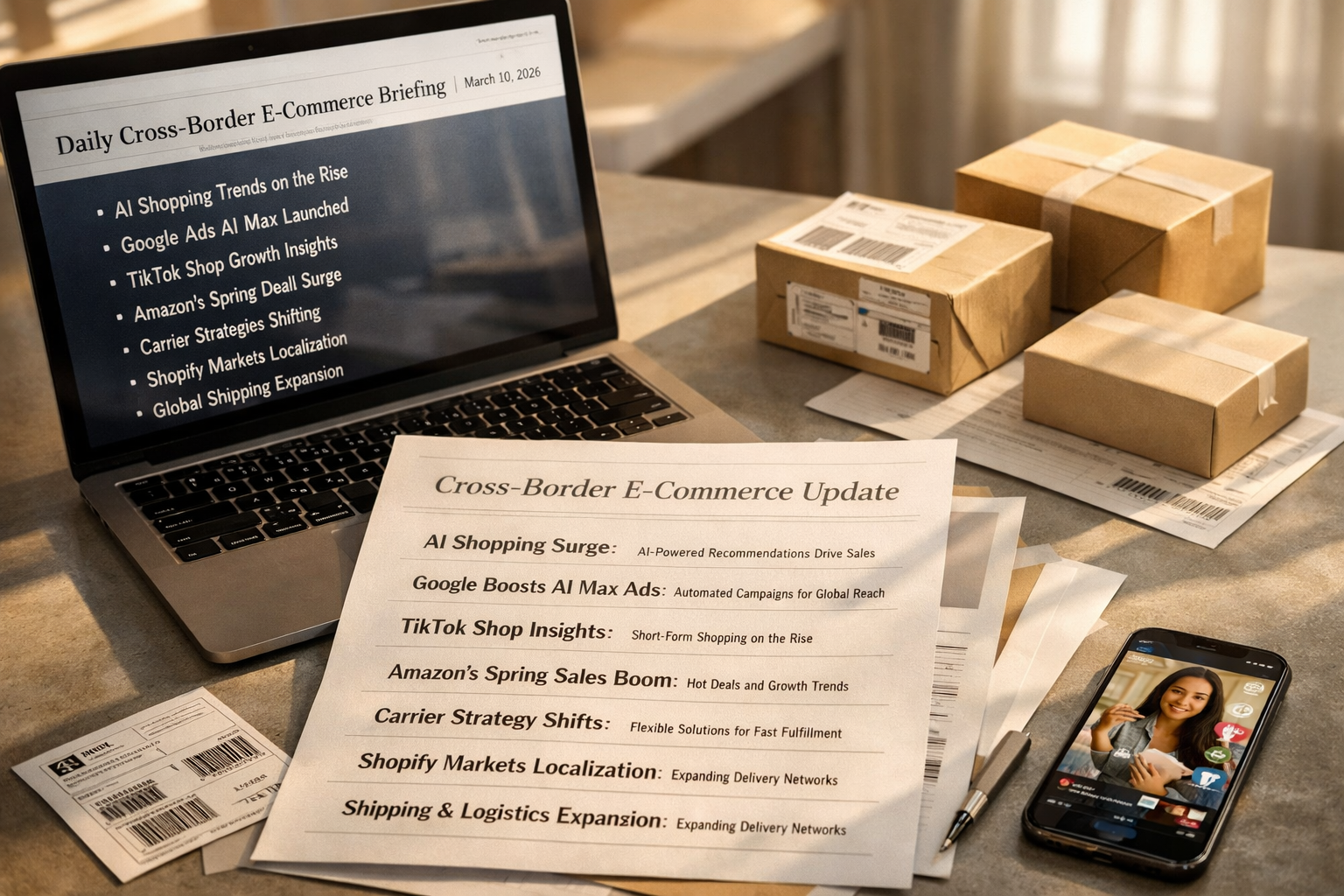
Daily Cross-Border E-Commerce Briefing | March 10, 2026 (Covering Mar 9 Releases)
1. Google Ads Pushes AI Max More Aggressively (Search Sellers Need Tighter Control Over Traffic Quality)
-
Google Ads is now surfacing a much larger recommendation card that pushes advertisers to enable AI Max directly from the Recommendations tab. The feature bundles text customization and Final URL expansion into an easier one-click workflow, which means more sellers will likely test or adopt it faster. For Shopify and WooCommerce merchants, this is not just a UI tweak. It is another sign that Google is steadily steering advertisers toward broader automation, looser query matching, and more machine-led expansion.
For independent-store sellers, this matters because AI Max can help uncover new search demand, but it can also widen traffic beyond your original keyword intent. That creates both opportunity and risk. If you run a simple one-piece dropshipping model and test products quickly, AI Max may accelerate learning on what search themes convert. But if your product pages, pricing, shipping times, or landing page intent are weak, broader matching can also waste budget faster. A practical approach is to test AI Max in controlled campaigns, watch search term quality closely, review landing-page relevance, and keep your delivery promises realistic so expanded reach does not create refund pressure.
Source: PPC News Feed, Published on: March 9, 2026
2. John Lewis Moves Toward AI Shopping and Launches a TikTok Shop Pilot (Discovery Commerce Keeps Expanding)
-
UK retailer John Lewis said it is investing in AI-powered shopping experiences that will place its products inside platforms such as Google Gemini and ChatGPT, while also launching a TikTok Shop pilot focused on beauty and gifting. For cross-border e-commerce sellers, this is an important signal: product discovery is moving further away from the traditional “search on Google, buy on website” path and deeper into conversational AI and social commerce environments.
This trend is especially relevant for lean independent brands and one-piece dropshipping stores because it rewards strong product data, fast content production, and impulse-friendly merchandising. Stores that rely on static listings and generic copy may lose visibility as shoppers increasingly discover products through AI assistants, short videos, and shoppable feeds. Sellers should improve product titles, simplify value propositions, prepare vertical creatives for TikTok-style discovery, and make sure product pages answer the fast questions buyers ask before they purchase: delivery time, product use case, trust signals, and return expectations.
Source: DecisionMarketing, Published on: March 9, 2026
3. Amazon’s Spring Promotion Window Is Back in Focus (Independent Sellers Should Prepare for Traffic and Price Pressure)
-
Amazon’s spring promotional cycle is ramping up again, with Spring Deal Days in Europe scheduled to run from March 10 to March 16, while the U.S. timing was still being closely watched at publication. Even for sellers who do not primarily sell on Amazon, this matters because Amazon-led sale periods often reshape shopper expectations across the wider e-commerce market. Consumers compare prices more aggressively, expect stronger offers, and become more responsive to urgency-driven messaging during large promotional windows.
For Shopify and WooCommerce merchants, the takeaway is to prepare your own campaign calendar instead of waiting to react. If you sell via a simple dropshipping workflow, this is a good time to identify products that can handle promotion without breaking margin, tighten supplier communication on dispatch speed, and build lightweight landing pages around seasonal intent rather than broad generic discounts. You do not need to mimic Amazon’s discount depth to benefit from the traffic shift. Often, clearer bundles, cleaner shipping communication, and faster product testing are enough to capture buyers who are already in deal-hunting mode.
Source: EcommerceBytes, Published on: March 9, 2026
4. UPS Says Its Future Is Less Dependent on E-Commerce Volume (Carrier Strategy Shifts Can Affect Seller Shipping Economics)
-
UPS indicated that it is moving toward a network with less emphasis on standard e-commerce volume and more focus on higher-value segments such as SMB, B2B, industrial, and healthcare shipments, while Amazon continues pulling shorter-distance deliveries into its own network. For online sellers, this is a meaningful logistics signal. When major carriers re-balance their networks around profitability rather than pure package count, service levels, pickup priorities, and pricing structures can gradually shift for smaller merchants.
For independent-store operators, especially those running one-piece dropshipping models, the lesson is not to depend too heavily on a single fulfillment assumption. If parcel economics change, thin-margin offers become fragile very quickly. This is a smart moment to audit delivery zones, refresh shipping-price tables, review carrier alternatives, and remove unrealistic “fast shipping” claims from product pages unless your supplier can consistently support them. The broader market direction suggests that seller resilience will come from flexibility: better shipping communication, simpler product mixes, and backup carrier options where possible.
Source: Supply Chain Dive, Published on: March 9, 2026
5. Flipkart Shifts Its Holding Company to India Ahead of an IPO (India’s E-Commerce Market Is Becoming More Strategically Important)
-
Walmart-backed Flipkart said it has shifted its holding company to India from Singapore, a move that helps pave the way for a domestic listing. For cross-border sellers, this is more than a corporate restructuring story. It highlights how India continues maturing as a major e-commerce market with stronger local capital-market confidence, deeper institutional support, and growing long-term significance in global retail strategy.
Sellers building independent stores should treat India as a market worth tracking more closely, not only for sourcing-related logic but also for consumer demand and future competition. As large local platforms and global players deepen their commitment, standards around payments, customer acquisition, and fulfillment will keep evolving. For stores testing international expansion, the practical opportunity is to start small with India-relevant research: payment preferences, mobile-first browsing behavior, price sensitivity, and category fit. Sellers using simple dropshipping workflows may find India interesting both as a demand market and as a competitive benchmark for lower-cost, high-volume commerce models.
Source: Reuters, Published on: March 9, 2026
6. Klaviyo and Shopify Deepen Integration Around Shopify Markets (Cross-Border Personalization Is Becoming More Native)
-
Klaviyo and Shopify announced a deeper integration designed to help brands scale international commerce more effectively, including support for Shopify Markets data and a new Locale Aware Catalog capability. In simple terms, this helps merchants sync market-specific product data into their CRM and marketing workflows more accurately, so they can present the right catalog information to the right audience in each region.
For independent-store sellers, this matters because cross-border growth often breaks down when storefront data and marketing data stop matching. If your emails, product recommendations, or automation flows show the wrong variant, wrong currency context, or wrong market messaging, conversion suffers and support pressure rises. Even small stores can learn from this direction. You should think in terms of localized commerce operations rather than only localized storefronts. That means aligning product titles, offers, destination messaging, shipping expectations, and post-click emails by market. For one-piece dropshipping sellers, this is especially useful when testing the same product across multiple countries with different consumer expectations.
Source: Klaviyo, Published on: March 9, 2026
7. New Transportation Procurement Tools Highlight a Bigger Trend: Shipping Decisions Are Becoming More Data-Driven (Small Sellers Should Borrow the Mindset)
-
Logistics.com has launched an updated procurement platform with added analytical tools for evaluating bid results and running “what-if” analysis before awarding carrier contracts. On the surface, this looks like enterprise logistics software news. But the underlying trend is more broadly relevant: shipping decisions are becoming more analytical, scenario-based, and cost-sensitive across the commerce ecosystem, not just inside very large supply chains.
Smaller online sellers can apply the same mindset even without advanced software. Review which destinations create the most support tickets, which products drive the highest shipping-to-margin ratio, and where carrier choices affect repeat purchase rate. For lean dropshipping stores, a simple spreadsheet that compares weight, dispatch time, refund rate, and delivery complaints by SKU can already produce better decisions. In other words, logistics optimization is no longer only an operations function; it is increasingly tied to ad ROI, conversion quality, and customer lifetime value.
Source: Digital Commerce 360, Published on: March 9, 2026
8. OnTrac Expands Its Marketplace Seller Program in More U.S. Metro Areas (Alternative Parcel Options Matter More for Seller-Fulfilled Orders)
-
OnTrac announced that it is expanding its marketplace seller and small-quantity pickup program into additional high-volume e-commerce markets across the Northeast, South, and Midwest in the United States. The program is aimed at seller-fulfilled marketplace shipping and is positioned to give more small and mid-sized sellers access to alternative parcel coverage and pickup options.
This is useful for independent-store sellers because parcel diversification is becoming more important as large carriers optimize for profitability and marketplaces keep raising buyer expectations. If you fulfill orders directly from suppliers or operate a lean dropshipping workflow, having more shipping options can improve flexibility on delivery promises, especially when you need region-specific solutions or want to reduce dependence on a single carrier path. The strategic takeaway is to monitor alternative last-mile partners, compare actual zone performance instead of relying on brand familiarity alone, and keep shipping messaging transparent on your storefront. In 2026, fulfillment agility is becoming a stronger competitive advantage for smaller online brands.
Source: PR Newswire, Published on: March 9, 2026


